

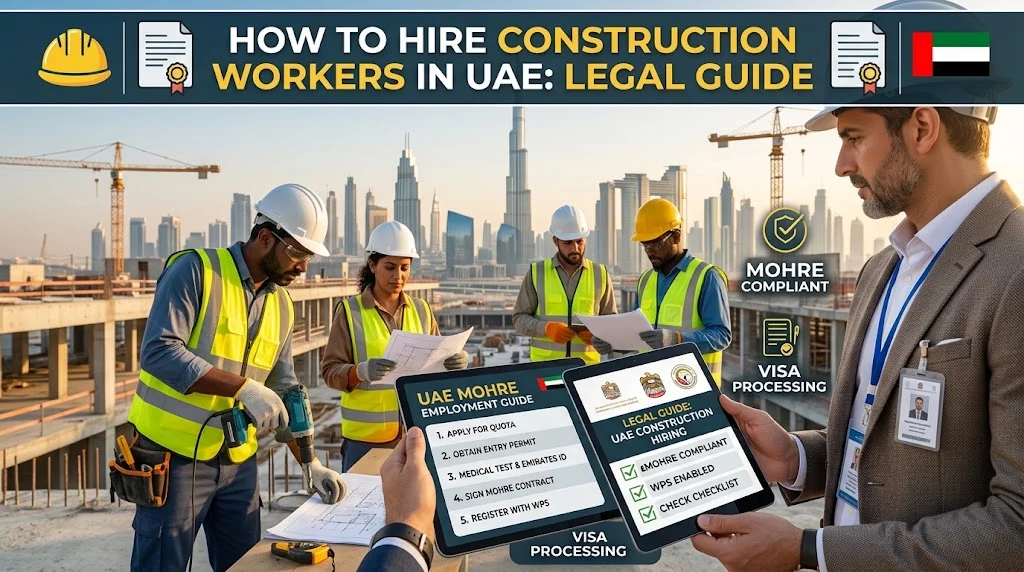
Staffing a construction site in the UAE takes careful planning, strict regulatory compliance, and a clear recruitment strategy. Whether you manage a massive civil infrastructure development in Abu Dhabi or a boutique commercial fit-out in Dubai, project schedules depend on your labor force. Missing workers mean stalled pours, delayed handovers, and severe contractual penalties.
This guide explains how to legally source, onboard, and manage construction workers across the UAE. We will cover the primary employment models, Ministry of Human Resources and Emiratisation (MOHRE) visa protocols, Wage Protection System (WPS) rules, worker welfare mandates, and practical budgeting breakdowns.
Choosing the Right Hiring Model
Before issuing offer letters or contacting recruitment agencies, decide which employment framework matches your project timeline and administrative bandwidth. Contractors in the UAE typically rely on three main models.
1. Direct Sponsorship (In-House Employment)
Under this model, your company acts as the direct legal sponsor. You manage the quota, issue work permits, process residency visas, and handle end-of-service gratuities. Direct hiring gives you complete control over training, productivity, and site loyalty. It works best for general contractors with continuous, multi-year project pipelines across the Emirates.
2. Licensed Manpower Supply Companies
If you need 40 steel fixers for an eight-week foundation pour, direct hiring takes too long. Labor supply companies provide on-demand workers under their own sponsorship. The agency manages visa processing, accommodation, transport, and statutory payments, while you direct daily site activities. This model provides rapid scalability, though hourly billing rates are higher.
3. Employer of Record (EOR)
Foreign engineering firms and international subcontractors entering the UAE often use an Employer of Record. The EOR acts as the registered local employer through its established entity. They handle MOHRE compliance, payroll, and benefits, allowing you to deploy workers without establishing a full mainland branch immediately.
| Hiring Model | Mobilization Speed | Administrative Burden | Cost Structure | Best Suited For |
|---|---|---|---|---|
| Direct Sponsorship | 4 to 8 weeks | High (Full legal liability) | High upfront, lower monthly unit cost | Permanent teams, long-term developers |
| Manpower Supply | 3 to 7 days | Low (Agency manages visas/WPS) | Zero upfront, higher hourly/monthly rate | Peak phase scale-ups, urgent labor gaps |
| Employer of Record | 2 to 3 weeks | Low (EOR manages contracts) | Monthly management fee per worker | Foreign firms testing the market |
Classifying Construction Labor Tiers
Defining exact job roles prevents skill mismatches on the job site. The UAE construction labor market organizes workers into four clear experience tiers:
- General Helpers & Laborers: Entry-level workers responsible for material staging, site clearing, basic excavation, and assisting trades. They work under direct supervision.
- Semi-Skilled Operatives: Workers with one to three years of experience handling repetitive trade-specific tasks, such as basic formwork, pipe laying, or scaffolding erection.
- Skilled Tradespeople: Certified masons, structural welders, MEP (mechanical, electrical, plumbing) technicians, and heavy equipment operators. They read technical drawings, operate complex machinery, and execute precise installations independently.
- Site Foremen & Supervisors: Bilingual trade leaders who coordinate daily task lists, manage material usage, enforce site safety, and liaise between project engineers and site crews.
Step-by-Step Direct Hiring and Visa Process
Employing construction workers under your own company requires working through MOHRE and the Federal Authority for Identity, Citizenship, Customs and Port Security (ICP), or the General Directorate of Residency and Foreigners Affairs (GDRFA) in Dubai.
Step 1: Obtain a MOHRE Quota and Establishment Card
Mainland commercial licenses require a MOHRE Establishment Card to register as an employer. Once registered, your company requests an electronic labor quota. MOHRE evaluates this quota based on your trade license activity, office space, registered engineers, and active project contract values.
Step 2: Issue the Standard Offer Letter and Work Permit
Generate an official MOHRE employment offer letter outlining basic pay, allowances, working hours, and benefits. The candidate must sign this document. Once signed, submit the application for an electronic work permit (entry visa) through the MOHRE portal or an approved Tasheel service center.
Step 3: Entry and In-Country Status Adjustment
If recruiting overseas (commonly from India, Pakistan, Bangladesh, Nepal, or the Philippines), the worker travels to the UAE using the pink entry permit. If the worker is already inside the country on a visit or cancelled visa, complete an in-country change of status to transfer them onto your company profile.
Step 4: Medical Screening and Biometrics
Every foreign construction employee must clear a mandatory health screening. This test checks for communicable diseases via blood tests and chest X-rays at an authorized medical fitness center. Following medical clearance, workers visit an ICP biometrics center to capture fingerprints and facial data for the Emirates ID.
Step 5: Contract Registration and Residence Stamping
Sign the standardized bilingual employment contract (Arabic and English). Upload the document to MOHRE for formal attestation. Once approved, the residency visa is officially stamped in the passport or issued digitally linked to the Emirates ID card.
Step 6: Mandatory Insurance Enrolment
Before deployment, contractors must secure compliant health insurance covering inpatient, outpatient, and emergency care. You must also register workers in the Unemployment Insurance Scheme (ILOE) to avoid ministry-level administrative fines.
Legal and Welfare Compliance Every Contractor Must Follow
Labor law enforcement across the UAE is stringent. Non-compliance results in heavy financial penalties, stop-work orders, or blacklisting from issuing future visas.
The Wage Protection System (WPS)
Under Federal Decree-Law No. 33 of 2021, all mainland contractors must disburse salaries through the electronic Wage Protection System managed by the Central Bank of the UAE. Wages must be paid on their due dates. A delay exceeding ten days triggers automated flags, while long-term non-compliance leads to an immediate freeze on all new work permits.
The Midday Work Ban
Every summer, from June 15 to September 15, the UAE government prohibits outdoor work between 12:30 PM and 3:00 PM. This measure protects workers from heat exhaustion and dehydration. Contractors must adjust site shift patterns, create shaded rest areas, and provide clean drinking water along with rehydration salts. Violations incur fines of AED 5,000 per exposed worker, up to a maximum of AED 50,000 for multiple staff.
Approved Worker Accommodation Standards
Contractors housing their own workforce must comply with Cabinet resolutions governing worker accommodations. Municipal inspectors verify:
- Minimum personal space allotments (at least 3 square meters per worker).
- Adequate central air conditioning and proper ventilation systems.
- Hygienic industrial kitchen facilities and clean dining spaces.
- On-site medical first-aid stations and isolation rooms.
- Proper sanitization facilities with specific toilet-to-worker ratios.
Working Hours and Overtime Rates
Standard working hours are 8 hours per day or 48 hours per week. During the holy month of Ramadan, working hours are reduced by two hours daily for all private-sector staff. Overtime is limited to a maximum of two hours per day. Work performed beyond normal hours requires payment of the standard hourly wage plus a minimum 25% premium, rising to a 50% premium for work conducted between 10:00 PM and 4:00 AM or on scheduled rest days.
Estimated Costs of Direct Hiring in the UAE
Budgeting for construction manpower extends well beyond base monthly wages. Below is an overview of direct sponsorship and monthly upkeep costs per worker.
| Expense Category | Estimated Cost (AED) | Payment Frequency |
|---|---|---|
| MOHRE Work Permit & Quota Fees | 300 – 600 | One-time (per 2-year visa) |
| Entry Permit & Status Change | 500 – 1,100 | One-time |
| Medical Fitness Screening | 250 – 350 | Every 2 years |
| Emirates ID Issuance | 270 – 370 | Every 2 years |
| Residency Visa Stamping | 400 – 650 | Every 2 years |
| Basic Health Insurance Policy | 650 – 1,200 | Annual renewal |
| Accommodation & Utilities | 400 – 700 | Monthly (per worker) |
| Site Transportation | 150 – 300 | Monthly (per worker) |
| Basic Salary (Helpers) | 1,000 – 1,500 | Monthly |
| Basic Salary (Skilled Trades) | 1,800 – 3,500 | Monthly |
Vetting Third-Party Labor Suppliers
Using unlicensed labor brokers is illegal in the UAE and poses massive financial risks. If you rent manpower from external agencies, run these verification steps before signing agreements:
- Check the MOHRE License: Demand an official copy of the supplier’s dedicated Manpower Supply License. General trading firms cannot legally lease workers to third-party sites.
- Verify WPS Settlement Proof: Request written proof showing the supplier processes payments through WPS consistently. If their bank file is flagged, their workers could walk off your site unexpectedly.
- Inspect Accommodation Camps: Visit the housing facility in industrial zones like Al Quoz, Jebel Ali, or Musaffah. Quality living conditions correlate directly with daily site productivity and reduced turnover.
- Audit PPE and Trade Certifications: Confirm the supplier provides required personal protective equipment, safety shoes, high-visibility vests, and verified trade testing records for skilled roles.
Managing On-Site Retention and Productivity
Hiring is only the first stage; retaining experienced crews protects your operating margins. UAE construction sites feature multicultural crews speaking Arabic, Hindi, Urdu, Bengali, Tagalog, and English. Clear visual instructions, color-coded safety signage, and multilingual tool-box talks prevent costly site rework and hazardous misunderstandings.
Pair new arrivals with seasoned crew leads during their first month. When workers see clear wage reporting, reliable transport, air-conditioned rest breaks, and prompt overtime settlements, site morale remains high. That stability allows your firm to deliver projects on schedule and within budget.
Frequently Asked Questions
Can a tourist or visit visa holder work on a construction site?
No. Employing individuals on tourist, visit, or transit visas is strictly illegal under UAE federal law. Violations carry fines up to AED 100,000 per worker for the contracting firm, alongside potential deportation of the individual and company blacklisting.
How long does the hiring process take for overseas workers?
Direct overseas recruitment takes between 4 and 7 weeks. This timeframe accounts for candidate selection, trade tests, medical clearances in the home country, MOHRE work permit approvals, entry travel, and local Emirates ID biometric capture.
Who is responsible for paying recruitment agency fees?
Under UAE labor regulations, the employer must cover all recruitment and visa processing costs. Workers cannot be charged recruitment fees or have visa expenses deducted from their monthly wages.
Can construction workers transfer between companies in the UAE?
Yes. Employees who have completed their probation or fulfilled their contractual notice requirements can transition to a new employer without requiring a No Objection Certificate (NOC). The new sponsoring firm initiates the transfer through the MOHRE portal.
How is end-of-service gratuity calculated for construction labor?
Under the revised labor law, full-time workers completing at least one year of continuous service receive 21 days of basic pay for each year worked during the first five years. For service beyond five years, gratuity rises to 30 days of basic pay per additional year, capped at two full years’ salary.