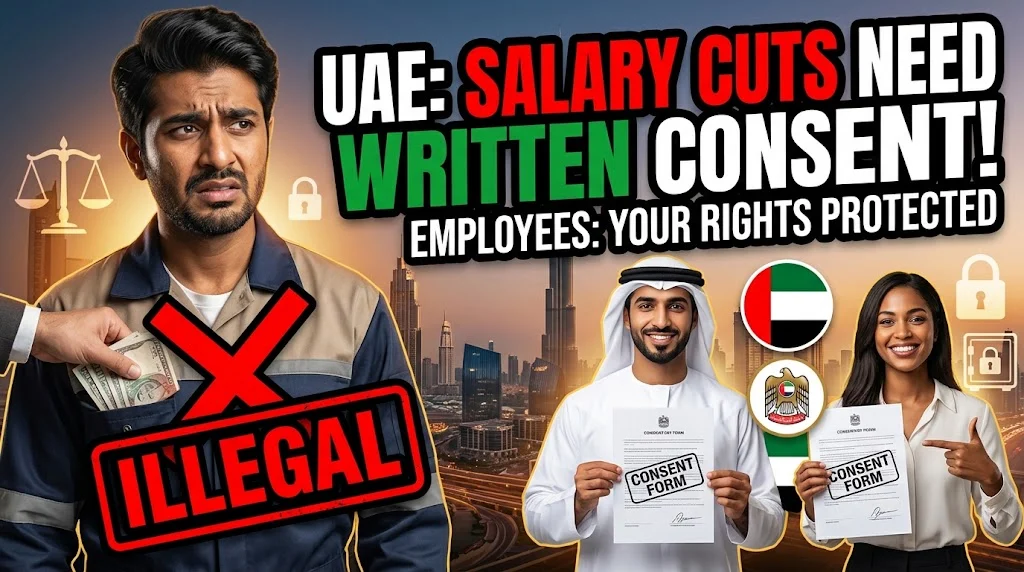
Receiving an unexpected email announcing a sudden salary slash can cause immediate stress and uncertainty. In the UAE, financial pressures, shifting market conditions, or corporate restructuring often tempt businesses to reduce overheads by cutting payroll. However, understanding your statutory protections under local legislation is essential.
UAE employment laws establish strict boundaries to protect workers, making it entirely illegal for an employer to reduce your wages, alter core contract terms, or force unpaid leave without your explicit written consent and formal Ministry approval.
The Legal Foundation: Why Unilateral Pay Cuts Are Illegal
Your employment contract is a binding legal document registered with the Ministry of Human Resources and Emiratisation (MOHRE). Under Federal Decree-Law No. 33 of 2021 on the Regulation of Employment Relationships, the basic wage, allowances, and total compensation package stated in that registered agreement cannot be altered on the employer’s whim.
Cabinet Resolution No. 1 of 2022 further reinforces this by mandating that employers pay the exact wages agreed upon through the Wage Protection System (WPS) on their designated due dates.
When an employer drops your monthly payout by 15 or 20 percent without a signed contract amendment, the law does not view this as a flexible adjustment. Instead, it classifies the shortfall as partial non-payment of wages.
Because the WPS tracks every dirham transferred against your registered file, unauthorized discrepancies show up immediately. Companies attempting to bypass these electronic systems face strict regulatory penalties, fines, and administrative blocks.
Valid Exceptions Under UAE Labour Law
While the baseline rule heavily favors employee protection, the legal framework allows for wage adjustments under very specific, controlled circumstances. Recognizing these rare exceptions prevents misunderstandings when dealing with company management.
- Voluntary Written Agreement: If you genuinely agree to a salary reduction and sign an official contract amendment through MOHRE electronic channels, the new wage becomes legally binding.
- Cabinet-Declared Emergencies: Extraordinary national crises permit temporary, proportionate measures under strict Ministerial guidelines. A private company experiencing a slow quarter or standard commercial loss does not qualify for this exception.
- Job Reassignment with Consent: Moving to a different role that carries a different pay scale requires your written agreement and an updated work permit modification.
The Hidden Trap: Basic Salary vs. Allowances Shifting
Some employers attempt clever workarounds, keeping your gross monthly earnings appear untouched while quietly shifting funds from your basic salary into variable allowances.
This trick carries severe financial consequences for employees. End-of-service gratuity calculations, overtime pay, and leave encashment are calculated exclusively using your basic wage.
Shrinking your basic pay while keeping total figures level quietly diminishes your future entitlements. This alteration still constitutes a contractual change, meaning it requires your formal consent and Ministry registration to hold any legal validity.
How to Protect Your Rights and Respond Properly
If your employer implements an unauthorized pay cut, your immediate response determines the strength of your legal standing. Silence or passively accepting reduced payslips for months can sometimes be interpreted by courts as implied consent, making recovery much harder.
Step-by-Step Response Strategy
- Object in Writing Immediately: Send a polite, clear email stating that you do not consent to the wage reduction, you expect your contractual salary, and you will continue performing your duties under your registered terms.
- Gather Your Evidence: Download your registered MOHRE contract, bank statements, WPS transaction logs, payslips before and after the reduction, and any written communications from management about the cut.
- File a Claim Through MOHRE: If the employer refuses to rectify the shortfall, submit an official salary complaint through the MOHRE app, website, or service channels. The Ministry mediates these wage disputes, aiming for an amicable settlement within 14 days.
- Escalate if Necessary: If mediation fails, the case transfers to the labour court system, where claims up to specified thresholds remain fee-free for workers.
What About Free Zones Like DIFC and ADGM?
Employees working within financial free zones such as the Dubai International Financial Centre (DIFC) or the Abu Dhabi Global Market (ADGM) fall under separate legislative frameworks rather than standard federal MOHRE regulations.
The DIFC Employment Law and ADGM Employment Regulations similarly protect employees from unilateral salary changes and require written consent for contract variations. However, dispute resolution in these zones routes through the DIFC Courts or ADGM Courts rather than Ministry mediation channels.