
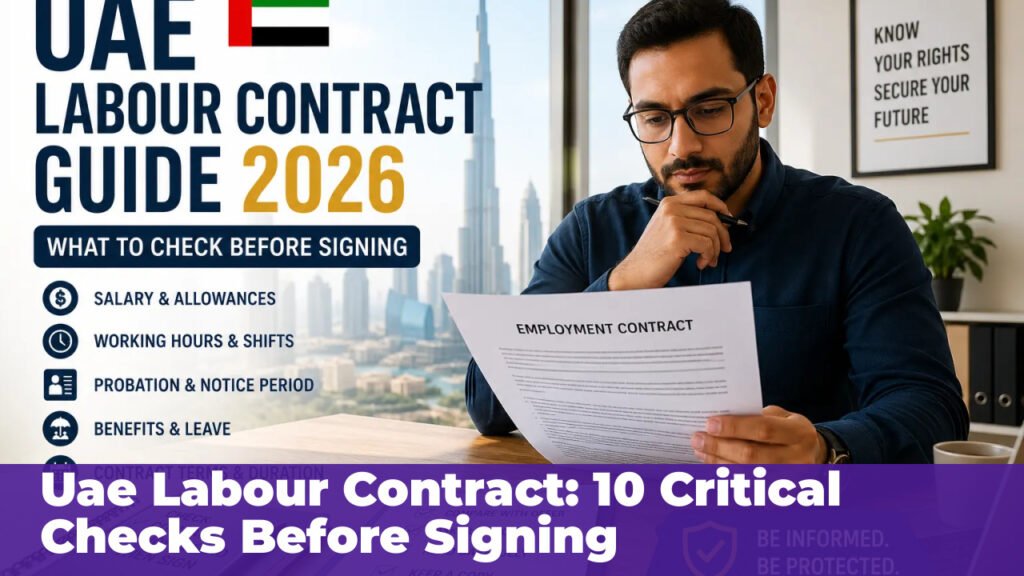
Accepting a job offer in the United Arab Emirates is an exciting professional step, but signing your formal labour contract requires careful scrutiny. In this guide, we break down everything you need to review before adding your signature to an official employment agreement. We cover the split between basic salary and allowances, statutory probation limits, working hours, notice periods, non-compete terms, and common red flags under Federal Decree-Law No. 33 of 2021.
Every private-sector mainland employee in the UAE works under a contract approved by the Ministry of Human Resources and Emiratisation (MOHRE). The terms in this document dictate your legal rights, your end-of-service gratuity, and your ability to transition to new roles in the country. Taking thirty minutes to verify every clause protects your career and financial security.
The Job Offer Letter vs. The Official MOHRE Contract
Many expatriates confuse the initial corporate offer letter with the official UAE labour contract. While an offer letter outlines the commercial agreement reached between you and the hiring team, the MOHRE standard contract is the primary legal document recognized by UAE labour courts.
Under UAE regulations, an employer cannot legally register a contract containing terms that are less favorable than those stated in your signed offer letter. When the MOHRE contract arrives via email or through an authorized Tasheel service center, place both documents side by side. Ensure the numbers, benefits, and job responsibilities match without discrepancy.
1. Salary Structure: Basic Wage vs. Allowances
Never evaluate a job package based solely on the total monthly figure. In the UAE, your total monthly compensation is divided into two distinct components: the basic salary and individual allowances (such as housing, transport, and utilities).
This division directly influences your long-term earnings because statutory benefits-most notably your end-of-service gratuity-are calculated exclusively on your basic wage. If an employer offers a total package of AED 12,000, they might split it as AED 4,000 basic wage and AED 8,000 in housing and transport allowances.
- End-of-Service Gratuity: Calculated strictly on your last basic wage under Article 51 of the UAE Labour Law.
- Overtime Pay: Overtime premiums are pegged directly to the basic hourly rate.
- Leave Encashment: Unused annual leave compensation reflects your basic pay plus basic allowances.
Aim for a basic salary that represents at least 50% to 60% of your gross monthly package. A basic salary that is set artificially low reduces your gratuity payout upon resignation or termination.
2. Contract Duration and Type
Following recent reforms in the federal labor framework, unlimited employment contracts have been completely abolished in the UAE private mainland sector. All private-sector workers must be on fixed-term (limited) contracts.
A standard fixed-term contract can be issued for up to three years and may be renewed for similar or shorter periods upon mutual consent. Verify your contract’s exact start date, completion date, and renewal conditions. If a contract lapses without a formal extension, continuing to work with the employer’s consent automatically extends the original terms under statutory protection.
3. Probation Period Clauses
Under Article 9 of Federal Decree-Law No. 33 of 2021, a probation period cannot exceed six consecutive months. An employer cannot place you on probation more than once for the same role.
Review the exact notice terms required during probation:
- Termination by the employer: The employer must provide at least 14 days’ written notice before ending your employment during probation.
- Resignation to leave the UAE: If you resign during probation to exit the country, you must serve a minimum of 14 days’ written notice. If you return to the UAE on a new work visa within three months, your new employer may be required to compensate your prior employer for recruitment costs.
- Resignation to join another UAE employer: You must provide at least 30 days’ written notice. The new company is legally obligated to compensate your current employer for recruitment and onboarding expenses.
4. Notice Periods and Early Termination
Check the notice period that applies after you pass probation. Under UAE law, notice periods must be between 30 and 90 days. The required notice duration must be identical for both the employer and the employee.
If an employer insists on a 90-day notice for you when you resign, but writes a 30-day notice for themselves if they terminate you, that clause is void under labor regulations. You are also entitled to full salary during the entire notice period, and employees serving notice are granted one unpaid working day per week to search for new employment.
5. Working Hours, Overtime, and Rest Days
The standard private-sector working schedule is a maximum of 8 hours per day or 48 hours per week, typically spread across 5 or 6 working days. During the holy month of Ramadan, working hours for all private-sector employees are reduced by two hours per day.
Review the provisions for overtime and weekend shifts:
| Work Scenario | Legal Compensation Rate |
|---|---|
| Standard Overtime (Daytime) | Basic hourly wage + minimum 25% premium |
| Late Night Overtime (10:00 PM – 4:00 AM) | Basic hourly wage + minimum 50% premium |
| Scheduled Rest Day / Weekend Work | Alternative day off OR basic wage + 50% premium |
Managerial and executive positions are frequently exempt from overtime payments under Executive Regulations. If you are joining in a non-managerial capacity, verify that your contract does not strip away your statutory rights to overtime compensation.
6. Annual Leave and Sick Leave Allowances
Your contract must clearly reflect your statutory leave entitlements. Under Article 29 of the UAE Labour Law, workers are entitled to:
- First Year of Service: Two days of paid leave per month if you have completed six months but less than one year.
- Subsequent Years: 30 calendar days of paid annual leave each year once you complete a full year of service.
- Sick Leave: Up to 90 days per service year (taken after probation), with the first 15 days at full pay, the next 30 days at half pay, and the remaining 45 days unpaid.
Also confirm parental leave rights (5 working days for mothers and fathers) and bereavement leave allowances, which range from 3 to 5 days depending on family relation.
7. Non-Compete Clauses
Employers often insert a non-compete clause to prevent staff from joining direct competitors. Under Article 10 of the UAE Labour Law, a non-compete clause is legally enforceable only if it meets three strict criteria:
- It must specify the exact geographic area where the restriction applies.
- It must clearly name the specific types of work that could cause measurable harm to the employer’s business.
- The restrictive duration cannot exceed two years from the contract expiration date.
If the wording is overly broad-such as restricting you from working in “any commercial enterprise across the entire Middle East”-the provision is unenforceable in labor courts. Ensure the clause is fair and narrowly defined before signing.
8. Visa Expenses and Passport Possession
A frequent violation among unscrupulous recruiters involves shifting visa and administrative processing fees onto candidates. Under UAE labor regulations, the employer is entirely responsible for all recruitment, work permit, medical screening, and Emirates ID costs.
No company can legally deduct visa processing fees from your monthly salary. Similarly, retaining an employee’s passport is strictly illegal under UAE Ministerial directives. Your passport is personal property; an employer may hold it temporarily only for residency stamping, after which it must be returned immediately.
9. Mainland (MOHRE) Contracts vs. Financial Free Zones
The regulatory authority overseeing your contract depends on where your employer is registered. Knowing which jurisdiction applies helps you verify your terms through the right legal framework.
| Jurisdiction | Governing Entity | Key Legal Framework |
|---|---|---|
| UAE Mainland | MOHRE | Federal Decree-Law No. 33 of 2021 |
| Standard Free Zones (e.g., DMCC, JAFZA) | Respective Free Zone Authority | Federal Labour Law with Free Zone administrative rules |
| Dubai International Financial Centre | DIFC Authority | DIFC Employment Law No. 2 of 2019 |
| Abu Dhabi Global Market | ADGM Authority | ADGM Employment Regulations 2019 |
If you are signing a contract within the DIFC or ADGM, remember that federal mainland labor laws do not govern your agreement. These common-law jurisdictions use their own specific statutory rules regarding notice periods, workplace benefits, and workplace dispute settlements.
10. Red Flags to Catch Before You Sign
If you notice any of the following warning signs, pause the process and ask for immediate written clarification:
- Discrepancies in Job Title: A title on paper that does not match your real job role can cause complications with skill categorizations and visa residency approvals.
- Undated Resignation Letters: Any request to sign an undated resignation document during onboarding is illegal and provides employers with an unfair mechanism to dismiss you without notice.
- Wage Protection System (WPS) Exemptions: Mainland businesses must pay salaries through the government-monitored WPS. Contracts suggesting cash payouts or foreign bank transfers bypass this security network.
- Disproportionate Penalty Clauses: Demands that employees pay tens of thousands of dirhams for resigning before the contract period finishes violate basic labor protections.
How to Verify Your Contract via Official Channels
Do not rely solely on printed documents handed to you by internal company recruiters. You can review and verify your official MOHRE contract directly through official UAE government portals:
- Visit the official MOHRE website (mohre.gov.ae) or download the MOHRE mobile application.
- Navigate to the “Inquiry Services” tab and select “View Approved Contract.”
- Enter your passport number, nationality, date of birth, or your transaction number provided by the hiring firm.
- Compare the digital contract stored in the ministry’s database against the physical document you have been asked to sign.
Remember that the Arabic text in a bilingual UAE labour contract serves as the legally prevailing version in local courts. If you do not read Arabic, ask a certified translation provider or an independent HR advisor to confirm that the Arabic section accurately mirrors the English text.
Frequently Asked Questions
Can an employer alter the salary on the MOHRE contract after I sign an offer letter?
No. Employers are legally bound by the terms outlined in the signed initial offer letter. If an employer submits a MOHRE contract with a lower basic salary or reduced allowances, you should refuse to sign and file an inquiry with the Ministry of Human Resources and Emiratisation.
What happens if I break a fixed-term contract early in the UAE?
Under current regulations, you can resign early provided you serve your contractual notice period (between 30 and 90 days). You do not incur arbitrary labor bans as long as you respect the statutory notice periods and comply with the contractual terms agreed upon in your MOHRE contract.
Is health insurance a mandatory clause in the contract?
Yes. Employers in Dubai and Abu Dhabi are legally obligated to provide basic medical insurance coverage for all staff from day one of employment. Federal health insurance mandates now extend these coverage requirements to all remaining emirates across the UAE.
Can my employer make deductions for damaged company equipment?
Article 25 limits any wage deductions for damaged company property or equipment to a maximum of five days’ salary per month. An employer cannot unilaterally make larger deductions without formal approval from MOHRE.
How can I resolve a disagreement before signing?
Address any discrepancies directly with the human resources department in writing. Point out the specific clause that contradicts your offer letter or interview agreement. If the employer refuses to align the document with official rules or previously agreed terms, you can contact the MOHRE contact center at 600 590 000 for official guidance.