

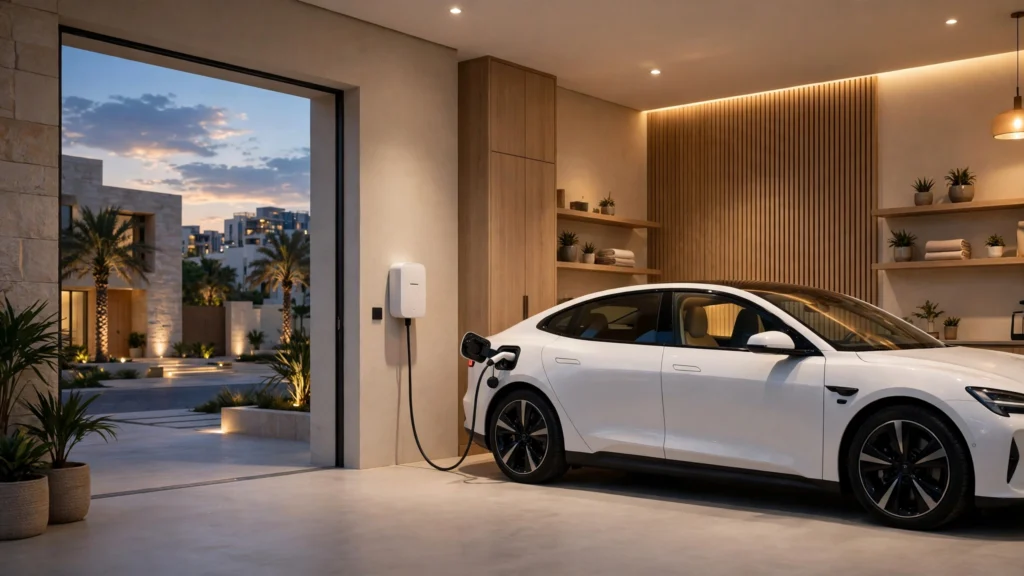
Charging an electric car at home is the cheapest way to run it in Dubai, and it is also the most convenient. Instead of planning your week around public chargers, you plug in at night and wake up to a full battery. A Level 2 AC wallbox rated at 7 kW or 11 kW gives a full charge in 6 to 10 hours overnight, which covers almost every daily routine.
Home charging is not a plug-and-play job, though. It is a regulated electrical upgrade, and it has to be done properly. This guide explains the costs, the installation steps, and the DEWA rules you need to follow in 2026.
Home Charging vs Public Charging: The Cost Difference
The main reason to charge at home is the price. Home electricity costs about AED 0.29 to AED 0.44 per kWh on the DEWA residential tariff. Public AC charging costs AED 0.70 per kWh plus VAT, and DC fast charging costs AED 1.20 per kWh plus VAT, under the unified tariff set by Cabinet Resolution No. 81 of 2024. Home charging is roughly half the price of public AC charging and about a third of the price of DC fast charging.
DEWA runs its own public network, the Green Charger network, which launched in 2014. It had grown to more than 1,860 charging points across Dubai by mid-January 2026. Public charging is useful for top-ups and long trips, but for daily use, home charging wins on price and convenience.
What Installation Involves
Installing a home charger is a regulated electrical upgrade, not a DIY job. The work must be done by a DEWA-approved electrical contractor. Doing it yourself is not permitted, and a poor installation can damage your car, your home wiring, or both.
Before anything is installed, the contractor assesses your property’s distribution board for available load capacity. If there is not enough spare capacity, the board may need an upgrade, which is common in older properties. The charger itself must carry at least an IP65 rating so it can withstand UAE heat, dust and sand. Each charger needs its own dedicated circuit, and the work must comply with DEWA’s EV Charging Technical Regulations, Dubai Building Code G.5.2, BS 7671 wiring standards and IEC safety codes.
If you live in an apartment or a villa community, you will also need a No-Objection Certificate (NOC) from building management or the Owners’ Association. Get this early, because it is often the slowest part of the process.
How Much Does It Cost?
- Charger hardware: AED 1,800 to AED 6,000. A 7 kW single-phase charger costs AED 1,800 to AED 3,500, and an 11 to 22 kW three-phase charger costs AED 2,500 to AED 6,000.
- Installation labour: AED 800 to AED 3,000 for a villa, or AED 2,500 to AED 5,000 for an apartment.
- Permits and inspection: AED 200 to AED 1,200.
A typical straightforward villa installation costs AED 3,000 to AED 6,000. Overall totals run AED 5,000 to AED 10,000, and apartments usually cost AED 4,000 to AED 9,000. Apartments cost more because the cable run from the parking area to the distribution board is usually longer and more complex.
How Long Does Installation Take?
A simple installation takes 1 to 2 weeks overall. In practice, villas take 3 to 5 weeks and apartments take 4 to 6 weeks, because of the NOC, the site survey and the scheduling of the contractor. Start the process before your car arrives if you can, so you are not relying on public chargers in the first weeks.
DEWA Rules You Should Know
DEWA does not typically issue a separate EV charger permit for residential installations, but the installation must still meet DEWA standards. That is why the contractor must be DEWA-approved. For larger set-ups, the rules are stricter: DC chargers above 50 kW in unrestricted-access locations need DEWA approval.
All Tesla vehicles sold in the UAE use the Type 2 (IEC 62196) connector. DEWA’s technical regulations specify AC chargers up to 22 kVA per charging point with Type 2 connectors, so a Type 2 wallbox will suit most cars on the road here.
One rule helps drivers directly. Under DEWA’s 2025 EV Charging Regulations, all public operators must offer a pay-as-you-go option, so no public charger can be subscription-only. You can always pay for a single charge without signing up.
Finally, home charging electricity is added to your normal DEWA residential bill. There is no separate EV tariff for home charging, so you pay the same residential rate as the rest of your home.
Choosing the Right Charger
- A 7 kW single-phase charger suits most homes and most cars. It charges overnight and is the cheapest option to buy and install.
- An 11 to 22 kW three-phase charger is faster, but it needs a three-phase supply, which not every home has. Check your distribution board before you pay for one.
- Check your car’s onboard charger limit too. A bigger wallbox only helps if your car can accept the higher power. Many cars cap AC charging at 7 or 11 kW.
Setting Up Home in Dubai
If you are new to the UAE and setting up a home here, it helps to sort your residency first. Read our guide: UAE Golden Visa 2026: Eligibility, Costs and How to Apply.
How Much Will You Save?
The savings add up quickly. A typical EV uses about 15 to 20 kWh per 100 km. At the home rate of AED 0.29 to AED 0.44 per kWh, 100 km costs roughly AED 4.35 to AED 8.80. The same distance on public AC charging costs about AED 10.50 to AED 14 plus VAT, and on DC fast charging about AED 18 to AED 24 plus VAT.
If you drive 2,000 km a month, home charging costs roughly AED 87 to AED 176 a month. Public AC charging would cost roughly AED 210 to AED 280 plus VAT for the same distance. Over a year, the difference can cover a large part of the installation cost, and after that it is pure saving.
The exact figures depend on your car and how much you drive, but the pattern is the same for every EV owner in Dubai: home charging is the cheapest way to run the car.
Frequently Asked Questions
Can I install an EV charger myself?
No. Installation must be done by a DEWA-approved electrical contractor. DIY installation is not permitted.
How long does it take to charge at home?
A Level 2 AC wallbox at 7 kW or 11 kW gives a full charge in 6 to 10 hours overnight.
Do I need permission from my building?
Yes. A No-Objection Certificate from building management or the Owners’ Association is required for apartments and villa communities.
Is home charging really cheaper than public charging?
Yes. Home electricity costs about AED 0.29 to AED 0.44 per kWh, against AED 0.70 per kWh plus VAT for public AC charging and AED 1.20 per kWh plus VAT for DC fast charging.
I live in an apartment. Can I still get a home charger?
Yes, but expect a longer process and a higher cost. Apartments usually take 4 to 6 weeks and cost AED 4,000 to AED 9,000, and you will need an NOC from building management.
Does DEWA issue an EV charger permit for homes?
Not typically for residential installations. There is no separate EV charger permit, but the installation must meet DEWA standards and be done by a DEWA-approved contractor.
Home charging is the simplest upgrade an EV owner in Dubai can make. Get a DEWA-approved contractor, get the NOC early, and pick a charger that matches your home’s supply and your car’s limit. Do that, and you will rarely need a public charger at all.