

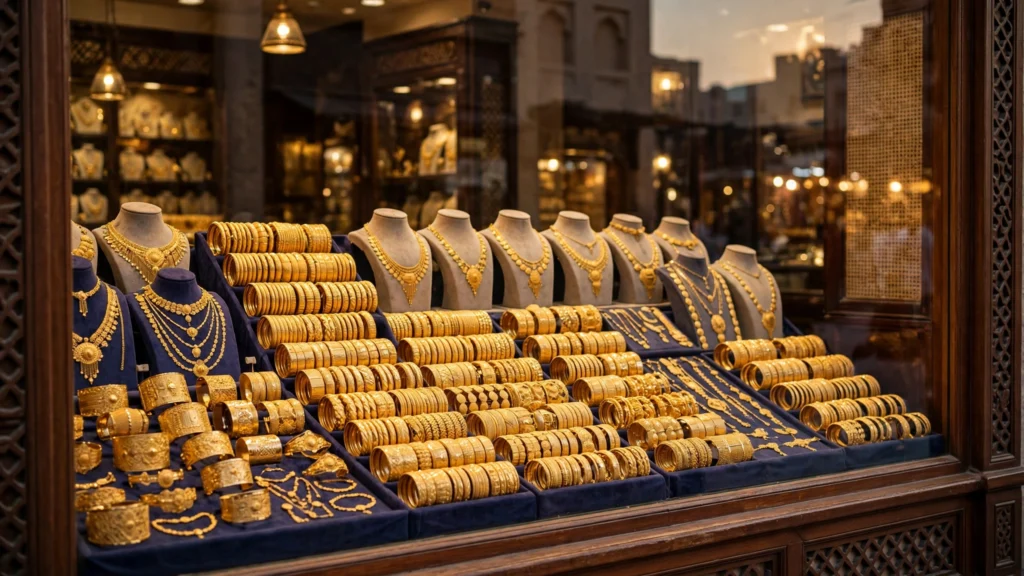
Dubai is one of the best places in the world to buy gold, and also one of the easiest places to overpay if you do not understand how the price is worked out. The good news is that the system is simple once you know it. In Dubai, gold is priced by weight at the day’s per-gram rate for the karat, plus a making charge, plus 5 percent VAT on the total. The daily rate is published by the Dubai Gold and Jewellery Group and is broadly the same from shop to shop, so you cannot haggle the rate, only the making charge. That is the key to this guide. We explain how the price is made up, what making charges usually cost, how VAT and tourist refunds work, what the different karats mean, where to buy, and how to check a piece before you pay. We do not give a live per-gram price in this guide, because the rate changes daily, so check the live rate on the day you buy.
How Gold Is Priced in Dubai
The total you pay is made up of three parts. First, the gold value, which is the weight of the piece in grams multiplied by the day’s per-gram rate for its karat. Second, the making charge, which is what the shop charges for turning the gold into jewellery. Third, 5% VAT, which applies to gold jewellery on the full amount, the gold value plus the making charges. Always ask for an itemised invoice that shows each part separately, so you can see the weight, the per-gram rate, the making charge and the VAT, and check that they add up to the total. If a shop will not show the breakdown, walk away and compare another shop. The per-gram rate itself is set by the market each day and published by the Dubai Gold and Jewellery Group, and shops use broadly the same rate, so a shop that quotes a much lower rate is usually making it up in the making charge.
Making Charges: What They Really Cost
Making charges typically run about AED 10 to AED 60 per gram, depending on the design. Plain 24K coins and simple bars are cheapest, at about AED 5 to AED 15 per gram. Simple chains and plain bangles are about AED 10 to AED 25 per gram. Standard necklaces and rings are about AED 20 to AED 40 per gram. Intricate bridal sets are the most expensive, at about AED 40 to AED 80 per gram or more, because they take the most work. That is why two pieces of the same weight can cost very different amounts. The making charge is also the part you can negotiate. Negotiating the making charge down by 20 to 40 percent from the opening quote is realistic on standard designs, so always ask, and always compare two or three shops for the same kind of piece before you decide. Do not accept a making charge that is quoted as a percentage of the gold value without checking what it works out to per gram, and do not accept a total price that hides the charge.
A Worked Example With Round Numbers
This is an illustrative example with round numbers, not a live price. Imagine a 22K necklace that weighs 20 grams. Suppose, only as an example, that the day’s rate is AED 300 per gram for 22K gold. The gold value is 20 grams times AED 300, which is AED 6,000. Suppose the making charge is AED 30 per gram, which is AED 600 for 20 grams. The subtotal is AED 6,600. VAT at 5% on AED 6,600 is AED 330. The total you pay is AED 6,930. If you can negotiate the making charge down from AED 30 to AED 20 per gram, the making charge falls to AED 400, the subtotal falls to AED 6,400, the VAT falls to AED 320, and the total falls to AED 6,720, a saving of AED 210 on the same piece. That shows why the making charge, not the daily rate, is where you save money. Always do this calculation yourself before you pay, and check the live rate on the day, because the real rate will be different from the round numbers used here.
VAT and Tourist Refunds
The 5% VAT rule is simple for jewellery. VAT of 5% applies to gold jewellery on the full amount, the gold value plus the making charges, as in the example above. The exception is for investment-grade gold bars and coins of 99.5% purity or higher, which may qualify for the reverse charge mechanism, effectively zero VAT. Ask the shop to explain the VAT on your invoice before you pay, and keep the invoice, because you will need it for a refund if you are a tourist. Tourists can claim a VAT refund under the Tourist Refund Scheme, run by Planet Tax Free, when leaving the country, subject to minimum purchase thresholds, and you should keep your invoices and ask the shop how the refund is claimed. Do not assume a shop that says no VAT is giving you a discount, as the VAT may be hidden in the price or the piece may not be what it seems.
Karats Explained
24K is 999 stamp, which means it is pure gold. It is soft, so it is best for coins and bars, not for jewellery you wear every day. 22K is 916 stamp, and it is the most popular choice for jewellery in Dubai. 21K and 18K are harder, and they are common for diamond-set pieces and for daily-wear jewellery, because they hold their shape and hold stones better. The karat affects the price, because a higher karat means more gold in the piece, so always check the karat stamp on the piece itself, and make sure the invoice states the karat, the weight and the making charge.
Where to Buy Gold in Dubai
The best-known place is the Deira Gold Souk, with more than 300 shops, the lowest making charges, and the best choice. It is best reached by metro, Al Ras station on the Green Line, and best visited from about 4pm into the evening, when the shops are open and busy. Meena Bazaar in Bur Dubai is another good area for gold, and the Gold and Diamond Park is a quieter, air-conditioned option with many jewellers in one place. Mall jewellers are also worth a look, especially if you want fixed prices and less haggling, although their making charges are usually higher than at the Souk. Whichever place you choose, compare two or three shops for the same kind of piece, and do not buy from the first shop you walk into.
Before You Pay: A Quick Checklist
Always check the karat stamp on the piece, and weigh the piece on a digital scale in the shop. Pay for net weight only, which is the gold alone, not the stones, and make sure the stones are priced separately if there are any. Get an itemised invoice that shows the weight, the karat, the per-gram rate, the making charge, the VAT and the total. Compare two or three shops for the same kind of piece, and negotiate the making charge, not the daily rate. Keep your invoice safe, especially if you are a tourist who wants to claim a VAT refund when you leave. If anything is unclear, ask the shop to explain it before you pay, and if a deal feels rushed or too good to be true, walk away.
Gold buying in Dubai is straightforward once you know the formula. Check the live rate on the day, work out the gold value, the making charge and the VAT, negotiate the making charge, and check the piece and the invoice before you pay. Do that, and you will get a fair price at the Gold Souk or anywhere else in Dubai.